A customer might start by searching for a service, ask an AI assistant to compare their options, then visit your website to see how you work. Each step brings a different question. Your website should give people enough information to move from “What do I need?” to “Who can help me?”
What’s the difference between SEO, AEO, and GEO?
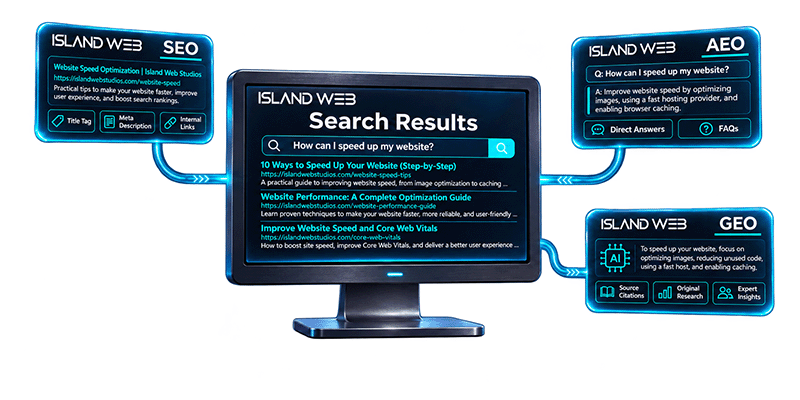
Search engine optimization (SEO) helps search engines understand your website and match its pages to relevant searches. We look at what each page covers, how it’s described in its title and headings, and how it connects to related pages. For example, a company that offers both website design and ongoing maintenance can give each service a dedicated page so customers land on the information they came for.
Answer engine optimization (AEO) focuses on answering specific questions clearly. If prospects regularly ask whether you work with their existing website, put the answer where they’ll see it. Explain which platforms you support, what access you’ll need, and what would require a closer look. Depending on the question, a short paragraph, a comparison table, or a step-by-step explanation may be the clearest format.
Generative engine optimization (GEO) focuses on making your content easier for AI systems to interpret and reference when they generate answers. We make important facts easy to identify and give claims enough context to stand on their own. A page that describes your process, shows a real example, and explains who the service is for gives readers and AI systems more specific information to work with.
These services often overlap on the same page. A clear heading helps a reader find an answer. A detailed example explains what your business does. An internal link gives someone a place to go when they’re ready to learn more.
Find the searches that matter to your business
We start with the services or products you want to grow. Then we research how customers look for them, what they ask before buying, and which pages would best answer those questions. That gives us a practical way to prioritize website improvements.
A search like “e-commerce website developer” may come from someone building a shortlist. That person needs to see what platforms you work with, examples of past projects, and how to request an estimate. Someone searching “how long does it take to migrate an online store?” may need a guide that explains what affects the timeline, from the number of products to integrations and redirect planning. Both searches are relevant, and each deserves a page that fits the decision the customer is making.
We also review the businesses and resources that appear for the searches you care about. We look for gaps you can fill with firsthand knowledge. If competing pages describe a service in broad terms and you can show what’s included, how the work is done, and what a customer needs to prepare, you have something concrete to add.
Improve the pages customers use to make a decision
A service page should answer the questions a prospect would ask on a first call. What’s included? Who is the service for? Can you work with what they already have? What affects the scope or cost? When your page answers those questions, prospects can come to the conversation with a clearer idea of what they need.
Our on-page SEO work can include:
- Title tags and meta descriptions that describe the page and give people a clear reason to visit.
- Headings and page structure that help readers find details about deliverables, timelines, and next steps.
- Service copy that explains what you do in language customers use and gives concrete examples of the work.
- Internal links that connect service pages, guides, case studies, and other relevant resources.
- Calls to action that tell visitors how to request a quote, schedule a consultation, or ask a question.
We also look for pages that overlap. If a general service page and a niche service page make nearly identical points, we clarify the job of each. The general page can help people understand the offering, while the niche page can address the requirements and questions specific to that audience.
Turn customer questions into content worth finding
Your best content ideas often come from the questions your team answers every week. We use those conversations to identify what belongs directly on a service page and what warrants a dedicated article, comparison, or guide.
Consider a business owner who asks, “Can I move my online store without losing my product rankings?” A short answer on an e-commerce development page can establish that you handle SEO during migrations. A linked guide can go deeper into URL mapping, redirects, and checks after launch. The service page helps a customer evaluate your offering, and the guide gives them a resource they can use while planning the project.
When several questions relate to one service, we can organize them into a topic cluster. Each page answers a distinct question and links to the next relevant resource. If you already have articles on the subject, we review which ones can be updated or connected before planning new material. [Explore our content strategy and creation services.](/content-marketing/)
Make your expertise visible in search and AI answers
Your website should make it easy to see who’s providing the information and why they’re qualified to speak about it. We look for places to add the details only your business can provide. Those might include a project example, a specialist’s explanation, an original screenshot, or a side-by-side comparison based on your work.
For example, “We improve website performance” is a broad claim. A project summary that explains how you diagnosed a slow mobile page, which changes you made, and what you measured afterward gives prospective clients something they can evaluate. If you have permission to share the results, we can incorporate them into a case study and link it from the relevant service page.
We also check for inconsistencies in how your business and services are described across your own site. If your homepage, service page, and contact page give different answers about where you work or what you offer, we help bring them into agreement. When crawlability, structured data, or page speed needs attention, we can address that through our [technical SEO and website performance services](/technical-seo/).
Measure visibility in terms that matter to your business
We agree on what to track based on your goals and the data available. For a service business, that might mean search impressions and clicks to priority pages, along with calls, quote requests, or booked consultations. For an online store, it might mean organic visits to category and product pages, along with orders or revenue where tracking is in place.
AI visibility can be reviewed using a consistent sample of questions customers are likely to ask. We can check whether your business is mentioned, which sources are referenced, and whether the response describes your services accurately. Those observations give you a snapshot. Answers can vary by platform, question wording, and time, so we use them alongside search and conversion data when deciding what to improve next.
Frequently asked questions
Can you optimize my existing website?
Yes. We can start with the pages you already have and identify changes to copy, metadata, headings, and internal links. If we find a problem in a shared template or your website’s structure, we’ll explain how it affects the pages you want customers to find.
Do I need separate pages for SEO, AEO, and GEO?
Your pages should be organized around what customers want to accomplish. A well-developed service page can answer a specific question, explain the service in depth, and link to evidence or examples. That same page can support all three approaches.
Can you guarantee a ranking or an AI citation?
Search engines and AI platforms choose what they display. We focus on the work we can control, including improving important pages, making information easier to understand, and tracking how visibility changes after updates.
How long does it take to see results?
Timing depends on your site, the competition, and the type of changes you make. We can confirm when updates are live and review visibility and inquiries over time. We prioritize work based on which pages serve your business goals and what’s currently holding them back.
Can you write the content and make the changes?
Yes. Island Web Studios can research the opportunity, write or revise the content, and implement website updates. If you have an in-house team, we can also provide a prioritized list of recommendations with page-level instructions.